While signing of the PACT Act by Pres. Trump is a step in the right direction in the fight against animal cruelty, it's not yet the sweeping change many of us were hoping for and would like to see. For example, states do not have jurisdiction. It applies to federal crimes and only federal law enforcement has any authority. We must continue to put pressure on local and state governments to pass their own laws to give authority to local enforcement agencies to address issues such as puppy mills, kitten mills, pet abuse, neglect, and random cruelty incidents.
The following sorts out the extent and scope of the new law.
Copied from the Holland & Muirden, Attorneys at Law Facebook page:
The PACT Act (Preventing Animal Cruelty and Torture Act) was signed into federal law yesterday! This is a great law that builds on 2010's Animal Crush Prohibition Act by making any activity defined as “animal crushing” potentially a federal crime, whether or not the act is committed as part of a crush video.
Unfortunately, there are lots of misleading and confusing headlines on this law, including that the PACT Act:
"makes animal cruelty a federal felony"
"makes cruelty to animals a federal crime"
"bans cruelty"
"makes animal abuse a federal offense"
is a "sweeping federal ban on animal cruelty"
covers "most animal cruelty"
The PACT Act DOES make some animal cruelty a federal offense, but it isn't that simple. Here are the basics:
What is "Animal Crushing?"
Animal crushing commonly refers to extreme fetish videos depicting animal abuse—where small animals are crushed, ripped apart, burned, or otherwise tortured to death. Usually, this is designed for the sexual gratification of the viewer. In 2010, a federal law was passed that banned the creation or depiction of such videos/acts, but NOT the actual underlying act of animal cruelty.
What does the PACT Act cover?
It outlaws purposeful crushing, burning, drowning, suffocation, impalement and other purposeful acts that cause “serious bodily injury” to animals other than fish. It prohibits some acts of sexual abuse against an animal, but this particular provision seems to have a qualifier that such acts are only prohibited if committed in the "special maritime and territorial jurisdiction of the United States."
It outlines exemptions for humane euthanasia; slaughter for food; recreational activities such as hunting, trapping, and fishing; medical and scientific research; normal veterinary, agricultural husbandry, or other animal management practice; unintentional acts; and acts that are necessary to protect the life or property of a person.
It does not apply to anything other than the specific acts of cruelty listed above.
It does not cover all acts of animal cruelty.
It does not cover acts of neglect (lack of food/water/care/shelter, etc.), abandonment, extreme weather, filthy conditions, or tethering issues.
It does not cover "puppy mill" issues.
Does the PACT Act change state and local law?
No. An offender can only be prosecuted pursuant to the PACT Act if the criminal act occurs on federal property (ex: national parks, military bases) or “in or affecting interstate or foreign commerce.”
The PACT Act was designed not to preempt or interfere with local/state animal cruelty laws or enforcement. The PACT Act is merely a federal overlay, exactly like the federal animal fighting law(s).
Who enforces the PACT Act?
Federal law enforcement in federal courts.
What are the possible punishments for violation of the PACT Act?
Violations could result in a fine and up to seven years’ imprisonment.
Does the PACT Act make all animal cruelty a felony?
No. As noted above, the PACT Act only applies in a narrow set of circumstances. State and local legislation to strengthen animal cruelty and neglect laws are still needed and very much necessary.
Saturday, December 07, 2019


Sunday, September 08, 2019
September is National Disaster Preparedness Month
There are many things to consider when you care about your pets' safety and welfare, especially during each storm season. September, for example, most commonly features hurricanes. Winter may present freezing and avalanche conditions. And summertime can bring devastating rain storms, tornadoes, and of course, extreme heat that can kill quickly without protection from the elements.
To prepare for each type of weather event, as well as unexpected disasters (wildfires, earthquakes, tornadoes and various man-made scenarios), anyone with animals to care for should create a plan to handle whatever comes up.
To prepare for each type of weather event, as well as unexpected disasters (wildfires, earthquakes, tornadoes and various man-made scenarios), anyone with animals to care for should create a plan to handle whatever comes up.
| A written disaster plan will help you and your pets survive. Identify your evacuation zone and level to determine if and when you would have to evacuate. If you are located in a storm surge area or flood plain, or in the path of a tornado, the decision to evacuate will depend on the category of the storm and on broadcast reports or warnings to do so. Always prepare for a worse emergency than is expected. If things do get worse, you won't have time to change your plans. Evacuation information, as well as additional preparedness guidelines, may be obtained from your local Emergency Management office. Your goal should be to evacuate to a safe location close to home, if possible. Long-distance evacuation is not recommended as highways will be crowded. Friends or relatives in a safe area are your best choice. The comfort of knowing you are safe together far outweighs any inconvenience. If they are unable to house both you and your animals, arrange shelter for your animals at a veterinarian or kennel close to your evacuation location so you will be able to have as much contact with them as possible. You and your pets will fare better if you are together. If you plan to go to a motel, determine in advance whether pets are welcome and what, if any, special rules are applicable. When you have determined a safe location for your evacuation, assist the host property owner in developing their disaster plan! Here is a great resource to help you create your plans: https://www.aspcapro.org/resource/dog-cat-safety-tip-sheets-case-disaster Also, please feel free to explore all the resources listed on my disaster website, here: http://ccadrt.1hwy.com |
Tuesday, November 06, 2018
Should we feed our cats the same diet day after day or provide some variety?
This may be more complicated than it appears. It's not a yes/no type of question, and is probably best answered, "It depends." Youngsters of most species are taught by their mothers, if they're lucky enough to still have them around, what foods are appropriate for their well being and are also taught the skills needed to obtain the right prey and how to eat them. In this case, predators such as cats must learn to hunt, perform the "kill bite" correctly, and how to dispatch the prey. They learn things like eating the organs first, such as the brain and stomach, to get the best nutrition. They also learn how to protect their catch from intruders who would steal their prize. (Does your cat swat at you if you get too close to her food dish while she's eating? This is why. Don't take it personally. Just respect kitty's need to eat undisturbed.)
While all this describes wild cats, these instinctive behaviors can help us understand why our sweet, gentle house-kitties still do some disturbing things, such as bringing you the mouse they just bagged, or other oddities in from outside if they have access to do so.
However, today's question probably applies most specifically to our household cats that never go outdoors. So I will forego the details of the hunt. Just realize that hunting is basic to any cat, even one that has no experience with it. However, just so you know, don't expect a tame cat to "go wild" if it gets outside and is expected to fend for itself. They do have to learn how to hunt properly and if they don't, they will not be successful and thus will not survive outdoors. The instinct exists but the skills must be learned.
So, in the interest of a housecat that never goes out, let's assume you just got a kitten. Depending on its age, you will want to feed an age-appropriate diet so it grows into the healthy cat Nature meant it to be. Kittens are in "learn mode" so you will be the teacher. If you teach baby kitties to eat only dry kibble (or some company's so-called "kitten food"), they learn to accept it as normal and may refuse anything else, even for the rest of their lives. But a single-source commercial food can have some risks, one of the most common being kidney disease.
Meat has moisture; kibble pretty much has none, maybe 10% at most. Cats aren't known for being big drinkers, so don't expect kitty to make up for that deficiency by drinking more. Again, instinct. Given that the cat is known for evolving from its desert-dwelling ancestors, they need moisture, and Nature provides it by giving them an appetite for meat. So the first thing you could try is offering the little ones some meat. It really helps if an older cat is present to demonstrate, as kittens learn by watching the older ones.
But if they are orphans, you will have to be the one to encourage them to eat meat. If they turn it down, try offering canned food, which can be up to 80% water. You can even add more water to this food to make a "kitty soup" to help them get enough moisture in their systems to prevent stress on the kidneys.
Also keep in mind that kittens are growing fast and have a high energy level, which requires frequent refueling with high energy kinds of food. Meat fulfills this requirement better than kibble, but if that's all they have access to, they need to eat often and a lot.
If you acquire an adult cat and it only eats dry food, you probably should try to offer some variety, especially food with moisture in it. The worst canned food is better than the best dry food, according to some veterinarians who really understand feline nutrition. But if you can afford it, it's worth it to use higher quality canned foods. Look for real meat as the first item in the ingredients list on the label. Then mix things up by feeding canned food made from different meats for variety, such as chicken, beef, pork, or even venison, duck and rabbit. This allows the cat to experience different flavors and benefit from the qualities different meats offer. Chicken has a higher protein content than beef, for example.
You will need to be patient with adult cats stuck in a routine as they usually need more time to learn new habits. Transitioning a cat to a new way of eating can take quite a while, so be patient and don't give up. My kitty Frosty took more than five years to accept raw meat. She still prefers her canned food for regular meals but recently seems to have decided that meat morsels make great treats. When she first got here, she only ate kibble, so she has come a long way.
You can find more information on this subject online by searching Cornell University's Feline Health Center.
https://www2.vet.cornell.edu/departments-centers-and-institutes/cornell-feline-health-center/health-information/feline-health-topics/feeding-your-cat
Also check out this site:
https://catinfo.org/commercial-cat-foods/ (Dr. Lisa Pierson)
Saturday, October 06, 2018
Does Your Cat Meow a Lot?
Why cats meow has always intrigued people and at times has led to some unfortunate misunderstandings.
Cats rarely "talk" to each other, as they are more into using body language and other physical signs to communicate with each other. But around humans, they've learned from watching us that we not only talk a lot, but we seem to expect them to talk back! So they do. They also learn that it's a very effective way to get our attention if they need or want something. It can help our relationships with them, but there are several situations that may lead to negative responses, or even life-threatening results, if they are ignored or punished.
Here are some reasons our cats meow:
1. Not surprisingly, there could be a health issue that is causing them pain or other distress. We need to heed their plaintive cries and check it out, even if it means a trip to the vet if you can't solve it quickly. I remember one older cat surrendered at my shelter who whined a lot, which is why the owner gave her up. After looking her over myself and not finding any sore spots or wounds, and a good range of motion for all joints, I looked in her mouth, expecting perhaps a bad tooth or gum disease.
She was drooling and her mouth didn't close completely. Using a flashlight, I discovered a tooth had broken off and lodged in the hinge area of her jaw, way in the back of her mouth. I reached in with some tweezers as a helper restrained her by wrapping her in a towel, and firmly grasped the tooth and slowly pulled it out. She flinched, of course, but after that, she was visibly grateful and had some cat food immediately, as if she had been starving for weeks. She probably was. She gained weight during her stay and finally was adopted to someone who was willing to pay attention to her needs.
2. Loneliness. Cats are social animals and though they adapt well to being the only pet in a household, they can and often do become lonely if their people don't pay attention to them. How would you like to live in a busy home, only to be ignored by everyone? They may be "independent" but they're not antisocial, unless they have to be. By the way, none of my cats can be called independent. I interact with them often and lovingly, and they are used to this, so they seek my attention frequently by calling me! Granted, that may annoy some people. But I have a great rapport with my kitties!
3. Plain old stress. Cats, like anybody, prefer to be comfortable, safe and free to enjoy their surroundings. If anything is disturbed or disrupted, they will adapt to it as well as they can, but not without consequences. If someone, such as another cat, a dog, or the kids are annoying them, teasing them, or hurting them in any way, they will generally hide out. But living under the sofa or bed all the time is not exactly an enriching environment and can lead to emotional problems. They may become silent, to avoid detection, or they may become cry babies, complaining about the conditions. It's up to us to help them be comfortable in their own homes.
4. They need or want something. Just like children, our cats may come to us to get them something, such as food, a favorite toy or invitation to play, or to let them out of or into another room and the door is closed. A common hint is how they will stare at the door knob.
5. Just sayin' hi. As mentioned, cats are social animals, so they may seek our attention by simply asking for it.
Tuesday, May 08, 2018
Sadly, my newsletter provider service is not working this month. All efforts and attempts to create and send this month's newsletter, The Kitty Times, have failed. Even the text-only version refused to send out to all of you on my list. I sent in several support requests but never got a response. So my only recourse is to simply publish the letter here, on my blog. This way it's also available to everyone!
So here is the May 7 edition for you (sorry, a couple days late):
First up, here are the holidays for May:
National Pet Month. (US)
Responsible Animal Guardian Month.
Pet Cancer Awareness Month. Sponsored by Pet Cancer
Awareness and the Blue Buffalo Foundation for Cancer Research.
Chip Your Pet Month.
National Pet Week--1st week of May
Be Kind to Animals Week--1st week of May
National Professional Pet Sitters Week
1st full week: American Humane’s Be Kind to Animals Week.
This week-long event has been celebrated since 1915. Always the first full
week of May.
May 1-7, 2016: National Pet Week. Always held the first full week of May by the
American Veterinary Medical Association.
May 3: National Specially Abled Pets Day
May 3: National Disabled Pets Day
Endangered Species Day - May 18, 2018 (Third Friday in May) There are big cats on that list!
May 8: National Animal Disaster Preparedness Day.
May 30 - Hug Your Cat Day! Some say May 3 others May 15. As for me, every day is Hug Your Cat Day!
And here are a few June holidays to get you started, since the newsletter comes out on the 7th.
June 4: Another Hug Your Cat Day!
June 3-9: Pet Appreciation Week. First full week in June.
June 9: World Pet Memorial Day.
FUN LINKS:
This is a very cute and very short video of an adorable kitty who makes quite
a face when she smells something interesting on her person's hand!
https://iheartcats.com/ragdoll-kitty-dramatically-reacts-to-catching-her-human-cheating/
--------------
WeRCats.com
This site is dedicated to sharing stories, videos, photos and anything
else about our fabulous furry feline friends. Feel free to explore their
many stories, share ideas and stories and ask questions about your cat.
------------------------------
Big Cats LOVE Catnip Too!
I love watching the big cats go crazy for catnip, just like our
little tigers at home!
http://blog.theanimalrescuesite.com/bigcat-catnip/
---------------------------
Pets Paint at Best Friends Animal Society
In between playtime, walks and training, animals at Best Friends
Animal Sanctuary engage in activities that enrich their lives, and
they create amazing works of art in the process. With a smattering
of animal-safe paint, they're making their world a little more beautiful,
and helping to find their forever homes in the process.
They are doing this project as a fundraiser, too, and you can purchase
some of the artwork. However, some of it is available for a free download
also. I picked up some new wallpaper of kitty pawprints for my screen
https://www.youtube.com/watch?time_continue=58&v=xMW-X8sjIqw
==================
HEALTH AND BEHAVIOR LINKS:
Do you know the signs of stress in your cat? Most cat people recognize
when their beloved pet is under stress, but many do not. Share the
information in this article with friends and others you know who may
not be offering the best care to their cats simply because they don't
realize their cat is under stress. Too many cats are punished for behavior
they can't help because their owners don't know the signs or how to help
them. There is good info on this site for dogs, too.
https://www.de-stressyourpet.com/
---------------------------
A warning about bobcat fever!
http://fox17.com/news/local/nashville-area-womans-cat-dies-from-bobcat-fever
--------------------------------------------------
PET FOOD
https://www.petful.com/recall-lists/cat-food-recalls/
Worried about pet food safety? Report Problems to the FDA!
http://catcentric.org/2015/09/22/want-safer-cat-food-it-takes-just-two-clicks-to-report-problems-to-the-fda/
http://truthaboutpetfood.com/
http://1.usa.gov/1q7Vi0c
http://www.petsadviser.com/pet-food-recalls/
http://www.littlebigcat.com/nutrition/why-dry-food-is-bad-for-cats-and-dogs/
Shelter feed links:
http://bit.ly/Food4Animals
http://www.freekibblekat.com/
------------------------------------
Helpful Links:
Share the #TruthAboutCats with your friends:
www.alleycat.org/TruthAboutCats
Disaster preparedness tips.
My disaster preparedness page for animals and people: ccadrt.1hwy.com
I just added more new links for the hurricane season.
Need help with your vet bills? This site offers some good information.
https://www.youcaring.com/blog/2016/need-help-with-vet-bills
-------------------------------------------
Past issues are stored at this link, if you would like to see them, and hope it works.
http://ymlp.com/archive_gqbyjegjgu.php
My email links:
hipaws @ hotmail.com
felinehelpline @ live.com
catsgalore4 @ hotmail.com
Just as a side note, I've also obtained a new domain, just in case something
weird happens to my old stand-by, the problemcat.com. Anything is possible
right now as I am in the process of reorganizing everything since my husband
passed away just before Christmas. We were partners in all the business ventures
we had going on the internet and now I must change the names and settings on
the many accounts we had set up.
The new site is called MyProblemCat.com
For now, it redirects to TheProblemCat.com, but I hope to relaunch it this
coming year with a new look.
See you next month!
RJ Peters, the Cat Lady
Tuesday, February 06, 2018
Getting Creative With Crates
Guest post by Rosalie Schultz
There has been a lot of criticism recently of
people who allow cats to roam outdoors. Books such as Peter Marra's Cat
Wars: The Devastating Consequences of a Cuddly Killer do make a point.
Roaming cats are clearly responsible for the deaths of many birds and members
of other valuable wildlife species.
This new emphasis on the harm done by outdoor cats
flies in the face of a lot of trap/neuter/release programs that have been
started around the U.S. as a way of putting feral cats to work controlling
rodent populations. I myself was the guardian of a feral colony in Chicago.
When my neighbor complained about the presence of roaming cats in her yard, I
oriented several of the cats to greater domesticity. But it's very hard to
re-condition alley cats to be satisfied staying indoors all the time. My cats
still use a pet door to spend some time in my yard almost every day. Attempts
at blocking off that pet door led to ferocious clawing, squalls, bad temper,
and persistent, destructive efforts at escape.
However, I have felt a little less guilty about
allowing my cats to continue some roaming behavior after I read an excerpt from
Charles Darwin's On the Origin of Species. In an early chapter of that
1859 ground-breaking work, Darwin says:
The murder of humble-bees in any district depends
in a great degree on the number of field-mice, which destroy their combs and
nests... Now the number of mice is largely dependent, as every one knows, on
the number of cats; and Mr. Newman says, “Near villages and small towns I have
found the nests of humble-bees more numerous than elsewhere, which I attribute
to the number of cats that destroy the mice.” Hence it is quite credible that
the presence of a feline animal in large numbers in a district might determine,
through the intervention first of mice and then of bees, the frequency of
certain flowers in that district! (Darwin and others of that era referred to
bumblebees as “humble-bees.”)
Researching this matter a little further, I found
a lot of people in the Victorian era had made a similar association between the
presence of sufficient numbers of roaming cats and the flourishing of their
gardens. In the rather sexist terms of that era, people would lament the
scarcity of “old maids.” That's because old maids were famous for keeping cats.
No old maids, no cats. No roaming cats and the rodent population exploded. An
exploding rodent population meant the destruction of bees' nests and therefore a
failure of flowers and crops to be sufficiently cross-pollinated.
I don't seriously think that an insufficiency of
feral cats is behind the collapse of bee populations around the world. However,
in helping to control rodent populations, feral cats might at least play a
small role in helping bees survive to do their vital work.
Incidentally, my cats DO control the rodent
population. They kill not only mice, but large rats. People have doubted that
cats will tackle hefty rats, but I can attest that my cats are lethal to even
the biggest neighborhood rats.
However, after having had my conscience salved a
little by reading Darwin's affirmation of the need for roaming cats, I was
still left with the fact that my cats were killing as many as 3-4 birds a week
that they caught around my bird-feeders. But I might have finally come up with
an effective way of greatly reducing the risk to birds.
Nothing I commonly saw recommended worked. No bell
collars, colorful clown collars, or typical fences, prevented my cats from
catching birds unaware. But – Eureka! I have found an answer that seems to
have cut down bird fatalities at my bird-feeders by about 90%. The answer is
milk crates!
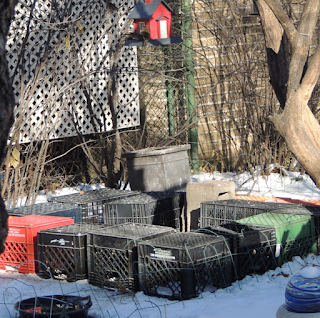
I collected a number of milk crates, the kind that
have the open lattice-work bases. I kept in place the low wire fence I had put
around the area under my bird-feeders. But inside that “compound,” I upended a
dozen or more milk crates. The wire fence by itself did almost nothing to slow
down my cats' attacks. But the cats absolutely cannot negotiate on top of or
around the massed milk crates. However, the birds can easily perch on top of
the plastic cross-pieces on these crate bottoms. And they can easily forage
between the crates for dropped birdseed. These crates can be moved in seconds
so that I can gain access to the bird-feeders to regularly re-fill and clean
them.
Below is a picture of the crates I've positioned
under my feeder. Given a little more time, I can collect or buy a more
attractive array of crates, possibly even creating a tiered, multi-colored
effect with them. Without getting too kitschy, I might also use the crates'
plastic lattice-work as supports for real or artificial flowers. By decorating
the crates with flowers, I would be making it even more difficult for the cats
to negotiate their surfaces, and I'd be making a colorful display that would
attract more birds and make the arrangement more visually appealing to
neighbors. A person could exercise no end of creativity grouping milk crates
into attractive landscape structures.

Saturday, November 26, 2016
Shop For Cat T-shirts!
With the holiday shopping season upon us, you may want to send some cool cat shirts to people on your list! Or, you can get one or more for yourself to show the world of your love for cats.
Then, if you need some ideas for gift-giving throughout the year, be sure to visit the T-shirt page anytime:
http://loveablecat.blogspot.com/p/t-shirts-for-cat-lovers.html
Then, if you need some ideas for gift-giving throughout the year, be sure to visit the T-shirt page anytime:
http://loveablecat.blogspot.com/p/t-shirts-for-cat-lovers.html
Tuesday, November 08, 2016
Busy year!
This has been a busy year here... busier than usual. I have to attribute that to the fact that I have an aging population of cats I've rescued and that did not get adopted. I would have to say, there is a "sweet spot" for adopting cats and once it's gone, those cats seldom find new homes. In general, if a cat is considered "too old" by potential adopters, the cat will be passed over.
Too old isn't the only reason, either. The black cats tend to be passed over as well. At one point, I had more than 10 black cats and an equal number of "tuxedo" cats. I still have some of them.
Many shelters simply remove "unadoptables" from their care to make room for the new ones that always come in. Yes, I'm referring to euthanasia, a sad but often inevitable fate in most animal facilities. I don't do that. Granted, it has left me to care for older pets with nowhere to go, and no room for newcomers. But they deserve nothing less than to enjoy and finish the life they were meant to have.
This summer I lost a number of older cats as they reached their lifespan limits, and it was sad to see them go. I will never forget them, as we became pretty close. Contrary to what a lot of people think, cats can become very bonded with and devoted to their humans and it has little to do with food. I have feline friends who are more loyal and loving than some people I know. If you have a cat like that, you know what I mean. Feel free to send me your story if you'd like. I can put it in here, or we can just share our experiences. My sweet girl, Holly, was the most recent loss, just a few weeks ago. She was 27.
Monday, April 18, 2016
Cat Whiskers Are Too Important to Mess With!

Have you ever known anyone who wanted to cut off a cat's whiskers to see what effect it would have on them? Some people do that, and it's more cruel than they can imagine. There is no need to do it! If you are actually curious, and not being mean on purpose, here is a better way to learn what a cat's whiskers mean to them.
One thing I did as a kid that instantly gave me a better understanding and appreciation of their "feelers" was to "try them on." Anyone who has cats knows they shed hair, and whiskers are shed, too, as they are a specialized type of hair. When you find one somewhere, save it, and the next one, though this works with only one if you're anxious to start.
Rinse it or them off in water or alcohol if you're concerned about germs or something, then put one lightly into each corner of your mouth, root end first. Now close your eyes and just feel your surroundings. You can feel subtle air currents, anything that comes close to you, and definitely if anything touches one. In fact, just touch one yourself. Try different weights of touch, from just barely to pretty strongly. Imagine if they are attached. You would not enjoy having them pulled on or out.
Look at the whisker, Note that it is tapered. The thicker end is attached by its follicle to the extraordinarily sensitive lip area, and it narrows to almost nothing at the outer end. Feel it. It's fairly thick at the base and very thin at the end. Try bending it. Brush one against your skin, your lips, your face.
Once you see and feel all the things that whiskers do, just imagine how much your cat depends on them.My blind cat kept hers pointed forward anytime she was on the move, as they served her much like a blind person's white cane.
Why would anyone want to take this special, often crucial, sense away from an animal?
For more information, read about Whisker Stress at PerPETuallyspeaking.blogspot.com.
Tuesday, March 10, 2015
Interview With a Senior Cat

Holly - Well, I'm not doing anything else, so why not? The sun is out and it's finally warm enough to sit on the deck railing again. Boy, what a winter! I hope it's over.
Me - I do, too! It looks like this is your favorite spot. I have a lot of pictures of you sitting here through the years.
Holly - Yes, it is. The deck is best in the morning when the sun is shining here, then I like to rest in the sunny spots in the laundry room for the afternoon.
Me - You just sit on the railing? You don't go anywhere?
Holly - No. At my age, I don't care to chase and play with the youngsters anymore. I have to hiss and swat at them to leave me alone when they try to entice me into one of their silly games.
Me - They probably have never seen any cats your age! So tell me, what's been going on since last year when I featured you on my blog for your 25th birthday?
Holly - Oh my, I'm on the internet? Did anybody say anything about that?
Me - Yes, a lot of people left birthday greetings, but we had some trouble with the internet and all the comments disappeared. I'll show you the ones that came in after that.
http://loveablecat.blogspot.com/2014/03/holly-is-25-welcome-to-birthday-party.html
Everybody admires you for being a great cat and living to such a ripe old age!
Holly - They do? Did you know that 26 cat years is like 120 human years?
Me - I did! I have a chart on that...somewhere....If I can find it, I'll put it in the Kitty Times newsletter again. Can you tell us the secret of your longevity, how you have managed to live so long?
Holly - I think one reason could be that I've never been left to fend for myself as an outside cat or ignored inside the house. I've always been loved. I think love is the most important factor in achieving a long life.
Me - I think that's true, and you're definitely one of the lucky ones. I'll never forget the day we brought you home.
Holly - Me neither! I was 15 then and it was a cold winter, like this year. I don't remember the date, though.
Me - It was in March, 2004. You've been here for 11 years.
Holly - Thank you for not sending me to live with anyone else, by the way. I knew you did that because you feared no one would want to adopt a senior cat. I missed my family for a while, but it's been good here, too. Say, did you ever find my actual date of birth?
Me - No, and that's why I chose March as your unofficial birthday.
Holly - That's OK, but I suppose that's why I'll never win the "oldest cat" trophy. We can't prove anything without papers.
Me - That's right, but we both know how old you are and I celebrate you every day for being here. Say, you look like you've filled out a little since last year, too.

Holly - Yes! I gained almost 2 pounds this year. Thanks for serving my favorite food....meat! We kitties are carnivores, you know.
Me - I know, and I respect that and want you to be happy and healthy.
Holly - I'm sorry I don't groom myself these days. I just don't like licking my fur anymore.
Me - That's OK. I enjoy brushing you. Sorry about having to shave the mats off, though.
Holly - I'm sorry, too. I just can't always keep my tongue in my mouth and the drool dries on my fur now and then.
Me - I understand. Well, it's been a long day and it's time to eat again. What would you like for supper?
Holly - You have to ask? OK, I'm ready! I know it's going to be the good stuff again!
Me - You got it, girl. Thanks for chatting with us and Happy Birthday again!

Thursday, November 20, 2014
Our New Kitten
This little sweetie came to us last month from a shelter a couple of hours away. She and her siblings were in need of special care as they all had ringworm. All 3 found homes, and we feel lucky to have her here. We have dealt with this condition before and she cleared up nicely.

We named her Dash, since that seems to be her favorite activity. From one end of the room to the other, she loves to exercise her growing body and hardly sits still.
Luckily, once she was clear, she and Sheba became instant friends, something they both needed.
Sheba, though just a kitten herself at 8 months, has adopted Dash and mothers her endlessly. Dash loves it, too, since she left her mother and siblings and might have become lonely.
Monday, September 01, 2014
Kitty has a name!
UPDATE: Our new kitty now has a name! She will be called Sheba. As a family member pointed out, she certainly thinks she's the queen of something, and Sheba came to mind first.

Check out my article on naming pets and you'll see why we felt it was important to select a name suggested by a member of the family. When everyone at home has a stake in the pet's presence, it helps to ensure they are all on board with proper care and consideration. Seriously, this cat is going to need extra patience and effort to help her become a part of this household.
Sheba is still very nervous about the other cats and has to be isolated when I can't be with her to supervise. She wears a harness during the day with a leash so I can hold her back when she tries to attack another cat. For now, she sits calmly by my chair at the computer and has accepted the leash. The other cats walk a wide berth around her, she growls, I give a little tug on the leash, and she settles down. She'll get used to everyone soon, but patience rules!
 She may be adopted but will need to be the only pet if people are not willing to work on helping her to relax and be calm. She does just fine when there are no other cats in the room. Her attitude may change after she's been spayed, too. For now, though, Sheba is a "work in progress" and we love her.
Check out my article on naming pets and you'll see why we felt it was important to select a name suggested by a member of the family. When everyone at home has a stake in the pet's presence, it helps to ensure they are all on board with proper care and consideration. Seriously, this cat is going to need extra patience and effort to help her become a part of this household.
Sheba is still very nervous about the other cats and has to be isolated when I can't be with her to supervise. She wears a harness during the day with a leash so I can hold her back when she tries to attack another cat. For now, she sits calmly by my chair at the computer and has accepted the leash. The other cats walk a wide berth around her, she growls, I give a little tug on the leash, and she settles down. She'll get used to everyone soon, but patience rules!
She may be adopted but will need to be the only pet if people are not willing to work on helping her to relax and be calm. She does just fine when there are no other cats in the room. Her attitude may change after she's been spayed, too. For now, though, Sheba is a "work in progress" and we love her.
Sept. 3 - What a difference a day makes! Or two. Sheba no longer needs her harness or the leash. She's quite at home and has accepted the 3 cats living in "her" room....the family room, where the computer is. She sits on my desk and helps write emails and stories. And when that gets boring, she zooms from one end of the room to the other....and back......and does swirls and tumbles along the way. She seems to be letting it all hang out now that she can relax and trust.
Next step, but not too soon, will be to meet the 12 cats that live upstairs! I think she can handle it. Do you? Leave a comment...thanks!
Next step, but not too soon, will be to meet the 12 cats that live upstairs! I think she can handle it. Do you? Leave a comment...thanks!
Wednesday, August 20, 2014
I need your help again....Name This Cat...
I need some suggestions for a name for this sweet little girl in the comments below.

This beautiful half-grown kitten magically appeared on our property over the weekend and needs a name. Yes, she needs everything else, too. Food, water, shelter, safety, and spayed! Living in the country is wonderful, but one drawback is the heartless abandonment of animals by people who think their unwanted ones will find love and a great future on some farm. All they have to do is drop them off and all will be well.
The reality is that many never make it. I have no idea how long this one was hiding in our shed, or if there are more in there who may be dead by now because they were too frightened to "speak up." One year, I found 18 kittens in my yard, left the night before, and though I gathered them all up, I found the 19th one the following spring....as a skeleton. It had crawled into a box and kept quiet. Never saw that one... No one owned up to the dump-off.
If people can't keep their animals, or "excess kittens" as they are called around here, they can easily take care of the problem. It's called spay and neuter. At the very least, take them to a shelter and explain the situation. Just don't abandon them indiscriminately in an area you think will be "nice."
Even if you know it would be, it's extremely presumptuous to dump an animal on someone else because you think they can afford it. If they want a new pet, it's up to them to decide when and where to get one.
So here are some names I found on several cat-naming websites. "Vote" for one, or send me your ideas. There is no deadline, but please, I don't want to keep calling her "the new cat" for too long. She'll get used to it! (Or I will...)
alyssa cleo cookie gracie jazzy tink zsa zsa
bacardi barley calypso gadget half pint
kabuki ladybug niblet paisley taffy skittles
veta vita waffles zephyr pepsi sparkle
bubbles gabby vanna autumn luna patch
patches pepper picasso speckles motley
(Highlighted names seem to be the most popular for now. Thanks to everyone who has sent me their comments.)
(Highlighted names seem to be the most popular for now. Thanks to everyone who has sent me their comments.)
Wednesday, April 30, 2014
Loveable cat provides round-the-clock care for old dog
[The following story was posted on April 30, when we all knew Buck's time was running out. We just didn't know when it would happen and wanted to give him as much happy time as possible. Well, the hourglass emptied on June 27, when Buck had to be taken to the vet because he could hardly breathe. He had developed a heart valve collapse and couldn't breathe fast enough while his heart was unable to pump oxygen to the brain. Too old for major surgery, it was clearly time to say good bye. He was happy to the very last moment and seemed grateful to "fall asleep" while we held onto him and spoke softly. RIP, Buck.]
Our cat, TG, short for Tripod Girl because she has three legs, is devoted to our old dog, Buck. He is about 11 now, but could easily be a year or two older than that. He was rescued from a wilderness area in 2009 in pretty bad shape. With no information on his situation, we'll never know his true age or how he ended up out there.
However, veterinary examination revealed that he was a senior, no doubt about that with badly worn teeth and a graying muzzle, and had been abused for an extended period, as seen by the horrific injuries I'm not going to mention. He also was much too thin, had tick fever, covered with hundreds of them when found, and had a variety of less severe maladies, including ear problems.
Most dogs rescued in such poor condition are immediately euthanized. But for some reason, Buck was spared. Perhaps it was his winning smile, which is what drew me to him when I saw a photo on the Internet. I contacted the rescue who had him and inquired about his status. He was scheduled to be put down that day. But I had fallen in love with him already and asked if I could give him a chance.
Happily, they agreed and thus began his road to recovery. He was kept in veterinary care for a couple of months for treatment and recovery and when strong enough, was neutered and vaccinated. Even so, by the time we all were able to work out a transport to get him to me, he weighed 42 pounds and had a few more weeks of antibiotics to finish.
Despite his years of suffering, or because of it, he was very happy to be taken into a loving home. He's been here more than four years now and is close to his normal weight - 75 pounds. He's very furry and looks bigger than he really is, so some people think he's overweight. Our vet says no.
Meanwhile, TG has taken him under her wings, er, paws, and caters to him all day and sleeps with him all night. She grooms him for hours at a time, and then cuddles against him or relaxes nearby to keep an eye on him.
 One would think Buck might appreciate this attention, but he never acknowledges her attention or presence.
TG herself is a victim of severe abuse, so perhaps she just understands Buck better than anyone else. She was caught in a steel jaw trap in 2005 and when I rescued her, she had to have a shredded front leg amputated to save her life.
It didn't take very long to recover from the injury, the surgery and the trauma, physically, but it took several years for her to let go of the emotional damage and allow us to show affection. We just didn't push it and allowed her to come around when she was ready for closeness.
Never push a cat to behave a certain way just to please yourself. They will respond when they are ready and you can help them become ready by proving you are not going to force them to do anything they don't want. Once she had watched us long enough to really know we were not a threat, she opened up and became a new cat! She is playful and happy, and now she has a job, too. She is Buck's end-of-life caregiver. I believe she knows he's not far from the end of his time on earth and feels compelled to comfort him, even though he hasn't shown any awareness of her devotion. This is true love, to care for someone without expectation of attention in return or in kind. I hope she doesn't get depressed when his time has run out. But we will be there for her, as she is for Buck now.
Our cat, TG, short for Tripod Girl because she has three legs, is devoted to our old dog, Buck. He is about 11 now, but could easily be a year or two older than that. He was rescued from a wilderness area in 2009 in pretty bad shape. With no information on his situation, we'll never know his true age or how he ended up out there.
However, veterinary examination revealed that he was a senior, no doubt about that with badly worn teeth and a graying muzzle, and had been abused for an extended period, as seen by the horrific injuries I'm not going to mention. He also was much too thin, had tick fever, covered with hundreds of them when found, and had a variety of less severe maladies, including ear problems.
Most dogs rescued in such poor condition are immediately euthanized. But for some reason, Buck was spared. Perhaps it was his winning smile, which is what drew me to him when I saw a photo on the Internet. I contacted the rescue who had him and inquired about his status. He was scheduled to be put down that day. But I had fallen in love with him already and asked if I could give him a chance.
Happily, they agreed and thus began his road to recovery. He was kept in veterinary care for a couple of months for treatment and recovery and when strong enough, was neutered and vaccinated. Even so, by the time we all were able to work out a transport to get him to me, he weighed 42 pounds and had a few more weeks of antibiotics to finish.
Despite his years of suffering, or because of it, he was very happy to be taken into a loving home. He's been here more than four years now and is close to his normal weight - 75 pounds. He's very furry and looks bigger than he really is, so some people think he's overweight. Our vet says no.
Meanwhile, TG has taken him under her wings, er, paws, and caters to him all day and sleeps with him all night. She grooms him for hours at a time, and then cuddles against him or relaxes nearby to keep an eye on him.
TG herself is a victim of severe abuse, so perhaps she just understands Buck better than anyone else. She was caught in a steel jaw trap in 2005 and when I rescued her, she had to have a shredded front leg amputated to save her life.
It didn't take very long to recover from the injury, the surgery and the trauma, physically, but it took several years for her to let go of the emotional damage and allow us to show affection. We just didn't push it and allowed her to come around when she was ready for closeness.
Never push a cat to behave a certain way just to please yourself. They will respond when they are ready and you can help them become ready by proving you are not going to force them to do anything they don't want. Once she had watched us long enough to really know we were not a threat, she opened up and became a new cat! She is playful and happy, and now she has a job, too. She is Buck's end-of-life caregiver. I believe she knows he's not far from the end of his time on earth and feels compelled to comfort him, even though he hasn't shown any awareness of her devotion. This is true love, to care for someone without expectation of attention in return or in kind. I hope she doesn't get depressed when his time has run out. But we will be there for her, as she is for Buck now.
Sunday, March 02, 2014
Holly is 25! Welcome to the Birthday Party!

We have decided to use the whole month of March to honor her birthday, especially since we don't know exactly what day she was born.
Below are some things to do at her "party" all month.
1. Let's get started with games to play to get into a festive mood!
2. To see more pictures of her, visit Holly's Album.
3. And here is a link to "mom's" free Petfood Report.
4. Mom's book page. Holly says, "I've already read all of mom's books, so get one for yourself or a friend. I'm even in one of them! All proceeds are used to buy my favorite cat food and to take care of any vet bills, too. There are other cats here, and they still need to eat and go to the vet also."
5. If you aren't getting the Kitty Times newsletter yet, just sign up for it at the top of this page, on the right.
6. If you would like to help without buying anything and just want to send a small amount to keep all of us in kibble, you can visit the Help page, at the very bottom when you get there.
7. And finally, here are some personalized items you can get from a favorite site of mine, Zazzle.com! The profits are tiny, but if they add up, it helps us get more kitty food and other things all the kitties need. Thanks for visiting Holly this month!
create & buy custom products at Zazzle
Saturday, December 21, 2013
Kitten season in the winter?
We moved out of town after the shelter closed so we could get away from people dumping unwanted animals in our yard. Well, some have found us, it seems. There aren't as many now, but we still get a few, and I can't be sure if it's on purpose or just random because some town people toss pets out of their cars in the country, thinking they'll find a fun life on a farm.
Typically, they need veterinary care as they haven't been altered, vaccinated or well cared for. So, along that vein, we've had two pregnant females left here in the last few months. (The others abandoned here happened to be fixed, at least.)
Sable and Leo are doing very well and are healthy. Leo is growing fast and is a delightful little boy. He will be neutered as soon as he's old enough, and his mother will be spayed.
The nameless one (help me out, if you like) gave birth in October to a wriggly, tiny one and left him on the cold concrete behind some boxes in the garage. I only found them because the little guy was crying so loudly. Good thing, or I never would have gotten to him. But I hope it isn't too late. He's not as healthy as our other kitten, possibly a premie? At the least, he's badly neglected by his own mother and I've had to step in and take over feedings. Even the vet is nervous about treating him because he's "frail" and too young for drugs or other treatments (such as, what?). That doesn't leave much but love to sustain him. And he's getting plenty of that.
Now 8 weeks old, he's still like a 4-week-old. And we're worried about his eyes. He was born with some infection, apparently, but we couldn't tell yet, because he didn't open his eyes at 10 days, as usual, but at 21 days, with help. Thanks to our vet, we are using a product I hadn't heard of before...Vetericyn. It's a non-drug natural product that fights infection. And it's working, but we won't know for a while if his eyes will normalize.
 Here he is, with mama, who won't let him nurse. At least she lets him be close to her for warmth and comfort. She's probably too young to have kittens and just doesn't know what to do.Being half wild herself, I can't do much with her yet. But she's gradually learning to trust me.
Contrast with Leo, who's growing like crazy:
 His mama, Sable, is very devoted and caring and looks after him diligently. She even plays with him as he gets into everything in the house! They have so much fun!
Typically, they need veterinary care as they haven't been altered, vaccinated or well cared for. So, along that vein, we've had two pregnant females left here in the last few months. (The others abandoned here happened to be fixed, at least.)
Sable and Leo are doing very well and are healthy. Leo is growing fast and is a delightful little boy. He will be neutered as soon as he's old enough, and his mother will be spayed.
The nameless one (help me out, if you like) gave birth in October to a wriggly, tiny one and left him on the cold concrete behind some boxes in the garage. I only found them because the little guy was crying so loudly. Good thing, or I never would have gotten to him. But I hope it isn't too late. He's not as healthy as our other kitten, possibly a premie? At the least, he's badly neglected by his own mother and I've had to step in and take over feedings. Even the vet is nervous about treating him because he's "frail" and too young for drugs or other treatments (such as, what?). That doesn't leave much but love to sustain him. And he's getting plenty of that.
Now 8 weeks old, he's still like a 4-week-old. And we're worried about his eyes. He was born with some infection, apparently, but we couldn't tell yet, because he didn't open his eyes at 10 days, as usual, but at 21 days, with help. Thanks to our vet, we are using a product I hadn't heard of before...Vetericyn. It's a non-drug natural product that fights infection. And it's working, but we won't know for a while if his eyes will normalize.

Contrast with Leo, who's growing like crazy:

Tuesday, December 10, 2013
Farewell to Rufus as he crosses over the Bridge
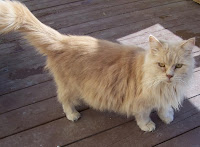
Rufus said good-bye to his earthly companions today and departed for the Rainbow Bridge after a long life, half in a horrible home, half here in my shelter. He was about 20, but we can't be sure. Coming from a hoarding situation, I'm sure his birth wasn't given any significance and he joined the dozens of other cats there. They all looked alike: pale orange, long hair, 6 or 7 toes on the front paws. There could have been some Persian in the mix, judging by his looks. He was here for 10 years and was possibly 10 when we rescued him and his "extended family."

With little or no socialization during those critical first few months, nor indeed, the ensuing years in that environment, he was not a cuddler. But he loved attention. This past week he was my constant companion, never letting me out of his sight. He followed me on my rounds as I did kitty chores, and he sat by my chair while I worked on the computer, staring at me.
I didn't allow myself to notice this slight change in his behavior, or I might have realized he knew he was winding down and was gathering memories to hold in his paws on that final journey.
Thus, it was somewhat of a surprise to see him reclining on the floor by my chair this morning and his inability to even raise his head. However, I'd been surprised daily by the fact that he was still here and eating well, and prancing about with no sign of slowing down. Today, he slowed down, and then he left.
I put him into a basket, as I always do for those in their final hours, and set him on the back deck in a sun puddle. It was as if the sun had come out for 2 hours just for him, and then disappeared into the overcast sky again as the temperatures dipped on the leading edge of our next storm.
Rufus was the last survivor from his family of 40 siblings, cousins and probably some offspring. The rest have all gone, and now Rufus is with them at last.
I miss him, as I do every cat who has graced my home and enriched my life.
Thanks so much to @ChatteMuse for a wonderful image of Mr. Rufus on his journey:

A very creative and lovely image to keep in mind in his absence. I appreciate the effort and loving gesture.
Saturday, October 19, 2013
Is It Halloween Again Already?
It seems like only yesterday, but here it is, another year gone by and we're shopping for costumes for the kids, and maybe even for our pets, too.
Remember these few pointers for a successful Halloween:

Enjoy your Halloween!
Remember these few pointers for a successful Halloween:
- Costumes should be comfortable and loose enough to allow movement without getting tangled.
- Most candy is toxic for animals, so the best approach is to just keep it all away from them.
- Electric cords and candles should be placed safely to avoid tripping on them and causing a fire.
- Keep your cat inside all evening. It's potentially hazardous outside, so just avoid it.
- It's especially hazardous for black cats, so keep them inside for a few days before and after the holiday.
- Be sure your cat is wearing a collar and ID tag just in case he becomes frightened and darts out the door when it is opened for visitors.

Enjoy your Halloween!
Saturday, July 06, 2013
Are You Making These 3 Mistakes With Your Cat?
Problem cats - or cat problems - are always a result of something human-gone-wrong.
That means it is up to us to fix it so we don't have to give up on our beloved pets
and send them away like it was their fault.
But first, we must understand the three most common mistakes people make with their cats.
Mistake No. 1 - Cats don't get even. They don't plot revenge against you. If you believe they do, then you're still viewing animals from the human perspective. To build a lasting and useful bond with a pet, it helps to see things as they do, from their angle.
Mistake No.2 - Blaming the cat for not using the litter box. Cats know how to use a litter box, even if they've never seen one before. If you think you need to train your kitten to use one, it's not exactly a waste of time, but it's unnecessary. Usually the mother cat takes care of this training, but if you've acquired a kitten before she had the chance to teach this habit, all you need to do is show the little one where the box is and maybe put him or her in it the first time so they can feel the sand. They get the idea.
Still, if a cat is not using the box, there are many things you can do to keep your cat from "thinking outside the box." Read my article on the 20 most common reasons a cat won't use their box: http://www.theproblemcat.com/articles/elimination.html
Mistake No. 3 - Cats are not aloof. Well, they can be if they need to be. Usually, this
behavior is simply "cats being cautious." If you lived with an unpredictable giant, you might walk carefully and quietly through the room with one eye out for unpleasant surprises, too.
Expecting your cat to adore you before he has good reason to do so is about building a relationship that is based on trust, not on how well you can force obedience.
Check out The Problem Cat and click the link to my book, How to Make Your Cat Adore You. Also, you may find the answers to some of your questions by just exploring the pages at the web site.
Tuesday, May 07, 2013
Next book is now available! Get Volume 2 here...
Thanks to our wonderful group of writers who love cats, the second volume in our series, Our Amazing Cats, is now available at these links:
https://www.createspace.com/4252359
http://www.amazon.com/dp/1484163443

https://www.createspace.com/4252359
http://www.amazon.com/dp/1484163443

Subscribe to:
Posts (Atom)